




EDUCATION
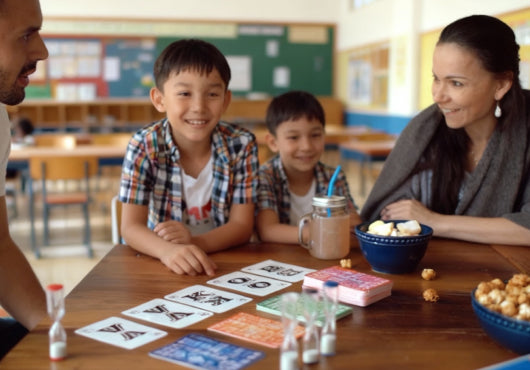
Studies are best learnt when they are fun, easy and practical. With the help of our games, children, teachers and families will be able to transform the learning of language and thinking skills into fun games. Apply these games in classrooms, at home, during therapy or even during family time. Through these games, kids may be able to develop new words, construct sentences, speak properly, think logically, collaborate and be creative all through playing

Equal playing field for wordsmiths and wallflowers alike1

No "right" answers means no pressure or judgment2

Constant creativity keeps everyone engaged every round 33

Built-in conversation starters that create lasting memories4
Special Offer
Grab this amazing deal now!
Learning Outcomes
| Game | Vocabulary | Communication | Logic / Reasoning | Teamwork / Social Skills | Creativity |
|---|---|---|---|---|---|
| What Is The Sentence | Excellent forward recall,sentence formation,grammar building | Strong speaking,listening, and expressive language practice | Requires quick reasoning to form meaning full sentences | Encourages discussion, judging, and peer interaction | FORM unique sentences from random letters |
| WAYS Communication Game | Supports better word choice and descriptive language | Core focus on listening, giving clues, and clear expression | Light reasoning based on interpreting partner cues | Strong — relies on cooperation and communication between players | Medium — players describe ideas |
| Logic Builder Game | Light vocabulary reinforcement | Requires discussions while solving puzzles | Strong focus on sequencing, problem-solving, and deduction | Encourages collaborative puzzle-solving and shared decision-making | Low–Medium — more structured than creative |
| Speed Words Challenge | Excellent for fast word recall, spelling, and language fluency | Helps with spoken language confidence and quick responses | Quick-thinking challenges strengthen mental processing | Encourages friendly competition and shared play | Medium —players create words or responses rapidly |
Our Kids Can Think Faster
What is the Sentence or W.I.T.S.
What can be claimed about “W.I.T.S.?”
- W.I.T.S. adapts to any classroom environment
- W.I.T.S. does not require a strong reading ability or specific vocabulary level for kids to participate
- W.I.T.S. promotes effective communication skills
- W.I.T.S. assists in reading development
- Spelling anxiety is eliminated when using W.I.T.S.
- W.I.T.S. improves communication skills
- W.I.T.S. helps kids to develop a greater vocabulary along with basic grammar skills.
- W.I.T.S. improves creative thinking skills
What is its power to teach?
- W.I.T.S. helps to teach sentence creation
- W.I.T.S. helps in teaching the development of phonemic awareness
- W.I.T.S. teaches basic math computation
What is its power to teach?
- W.I.T.S. helps kids to develop larger vocabularies faster
- W.I.T.S. better helps to stimulate kids minds and understanding through its unique way of word usage
W.I.T.S. action cards stimulate conversation about concepts kids often hear but rarely contemplate
What will parents want for their child?
- Parents know that when using this fun task that their kids will be learning from it
- Because of W.I.T.S. high replay appeal parents know that the more their kids use W.I.T.S. that their kids will improve their basic oral and communications skills
- Parents can use W.I.T.S. with their kids at home and see the results of the activity
- Even though W.I.T.S. is a fun task parents love it because it is challenging
- Parents see that when their kids use W.I.T.S. they are able to exercise their verbal creativity
Latest Articles
VIEW ALL
Family game night becomes something special when the games connect to faith. Bible games do more than fill an evening....
READ MORE
How to Replace Kids Screen Time with Bible Time
Children aged 8 to 18 in the United States spend an average of 7.5 hours per day on screens outside...
READ MORE
How Much Screen Time Are Kids Getting and What Parents Can Do About It?
Children aged 8 to 18 in the United States spend an average of 7.5 hours per day on screens, outside...
READ MORE

